Why Electricity Bill Is High This Month in Pakistan?
Last updated: 17 October 2026. The rates and adjustments are taken from the NEPRA notifications and news reports listed at the end of this page.
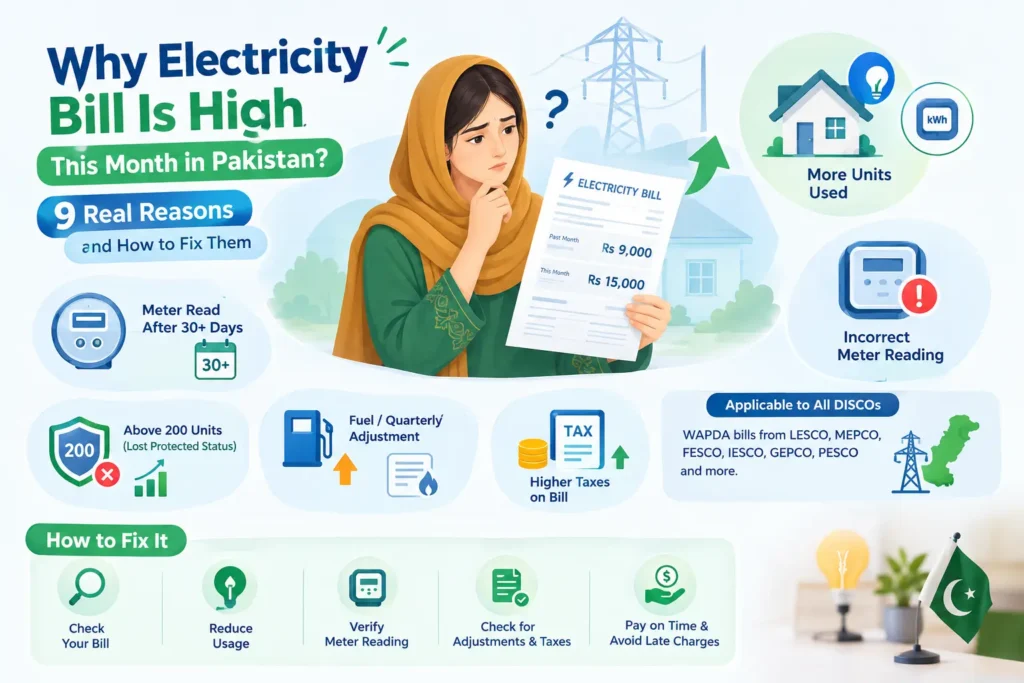
When you look at the bill the figure appears to be incorrect; it was Rs 9,000 last month and Rs 15,000 this month, even though, as far as we can see, nothing in the house has changed.
The short answer is that the reason your electricity bill is high this month is generally because one or more of the following have occurred: you have used more units, you have gone above the 200-unit mark and therefore lost your protected status, a fuel or quarterly adjustment has been included, the taxes have increased along with the bill, the meter was read after more than 30 days, or the meter reading was incorrect. A single bill can have three or four of these reasons at the same time.
The guide sets out each reason using simple language, illustrates a actual bill item by item, and provides you with the steps you need to examine your bill and reduce it. It is applicable to WAPDA bills from all the DISCOs, such as LESCO, MEPCO, FESCO, IESCO, GEPCO, PESCO and the rest, since tariff rates for homes are the same all over the country.
First, Compare Your Last Three Bills
Before you try to work out why your electricity bill has been high this month, lay your last three bills next to each other and look at three points: the amount of units used, the billing days, and the additional lines such as FCA or QTA.
When the readings rise significantly, the reason is either due to increased usage or because of the meter. If the readings are almost identical but the amount has still jumped, then the cause must be a change in the tariff, the loss of protected status, or an adjustment. This single step eliminates the need for guessing.
You can view your previous bills for free on the DISCO website or app by entering your 14-digit reference number, which will provide you with a full record of your electricity usage for the year.
Reason 1: You Used More Electricity Than You Think
Electricity is measured in units, one unit being equal to one kilowatt hour (kWh); therefore, if an appliance which has a power rating of 1,000 watts is used for one hour it will use up one unit.
Small habits can accumulate; for example, a fan running day and night, a water pump that fills the tank twice, an iron being used for an hour, or guests staying for a week can all cause the meter to rise. The situation is even more severe in summer since air conditioners are the main consumers of electricity in most houses.
If you want to know how much you are using, divide the number of units shown on your bill by the number of billing days. For example, if your house uses 12 units each day, then it uses 360 units over 30 days, which puts you well above the 200 unit figure mentioned below.
Reason 2: You Crossed the 200 Unit Line
Of all the explanations given for why the electricity bill is so high this month, this is the most upsetting one, and many families don’t find out about it until the bill comes.
There are two kinds of home customers in Pakistan. A home is classified as a protected consumer if it has used 200 units or fewer in every month of the last six months. Such a home is charged the lowest rates. All the other homes are considered unprotected and have to pay a much higher amount per unit.
The basic energy rates included in the schedule announced by SRO 279(I)/2026 are given in the sources listed below.
| Monthly units | Protected (Rs per unit) | Unprotected (Rs per unit) | ||||||||||||||||||||||||||||||||||||||||||||||||||||||||||||||||||||||||||||||
|---|---|---|---|---|---|---|---|---|---|---|---|---|---|---|---|---|---|---|---|---|---|---|---|---|---|---|---|---|---|---|---|---|---|---|---|---|---|---|---|---|---|---|---|---|---|---|---|---|---|---|---|---|---|---|---|---|---|---|---|---|---|---|---|---|---|---|---|---|---|---|---|---|---|---|---|---|---|---|---|---|
| 1 to 100 | 10.54 | 22.44 | ||||||||||||||||||||||||||||||||||||||||||||||||||||||||||||||||||||||||||||||
| 101 to 200 | 13.01 | 28.91 | ||||||||||||||||||||||||||||||||||||||||||||||||||||||||||||||||||||||||||||||
| 201 to 300 | Not applicable | 33.10 | ||||||||||||||||||||||||||||||||||||||||||||||||||||||||||||||||||||||||||||||
| 301 to 400 | Not applicable | 36.46 | ||||||||||||||||||||||||||||||||||||||||||||||||||||||||||||||||||||||||||||||
| 401 to 500 | Not applicable | 38.95 | ||||||||||||||||||||||||||||||||||||||||||||||||||||||||||||||||||||||||||||||
| 501 to 600 | Not applicable | 40.22 | ||||||||||||||||||||||||||||||||||||||||||||||||||||||||||||||||||||||||||||||
| 601 to 700 | Not applicable | 41.85 | ||||||||||||||||||||||||||||||||||||||||||||||||||||||||||||||||||||||||||||||
| Above 700 | Not applicable | 47.20
Homes that use up to 50 units have to pay 3.95 rupees per unit and those using between 51 and 100 units pay 7.74 rupees per unit. On a number of websites the figure of 47.69 rupees is still displayed, although this is an outdated amount. The difference between the two groups is great. Consider the situation when there are just 10 additional units: ⚡
Just 10 Extra Units Can Add About Rs 4,500
Protected vs unprotected base energy charge, before taxes and adjustments
The home with protection charges 100 units at Rs 10.54 and 95 units at Rs 13.01, while the home without protection has to pay all 205 units at the fixed rate of Rs 33.10. The difference in cost before any tax or fixed charge is approximately Rs 4,500, resulting from 10 units. Once you have gone over 200 units, you won’t immediately regain protected status. In July 2026, K-Electric said that a house could regain protected status if it remained at 200 units or below for six months in a row. The other DISCOs also apply the same six-month rule. The Power Division has likewise been looking into whether the penalty should only apply for the month in which excess use occurs, but since this is just a proposal, you should plan on the present rule. Reason 3: Fuel and Quarterly Adjustments Were AddedOne reason why your electricity bill has been high this month is that there are lines which you do not control. The bill includes lines that change each month even though your own habits have not changed. The two main ones are FPA and QTA. FPA, which is now shown as FCA (fuel charges adjustment) on most bills, deals with the difference between the fuel cost that NEPRA had assumed and the fuel cost that the power plants actually paid. If fuel costs turn out to be higher than expected, this extra amount is included on your bill; if fuel costs are lower than expected, you receive a credit. NEPRA announced a positive FCA of Rs 1.1086 per unit for August 2026; the actual fuel cost was Rs 8.2084 per unit as compared to a reference figure of Rs 7.0998, and the additional amount will be included in the October 2026 bills. In July of that year the adjustment had been Rs 2.06 per unit and this had been collected in the September bills. Thus, the amount you pay for the same units can vary by more than a rupee in one month. The quarterly tariff adjustment (QTA) includes expenses other than fuel, such as payments for capacity made to power plants and the costs of operation and maintenance. NEPRA has approved a positive QTA of Rs 0.5194 per unit for the quarter covering April to June 2026, with the charge to be invoiced in September, October and November 2026. The same adjustments are made to your bill, so the larger the house the greater the amount you have to pay. Most Lifeline customers and those on the prepaid tariff are generally not included. Reason 4: Taxes and Fixed Charges Grow With the Bill⚡
Taxes and Charges on Your Electricity Bill
What each line means and how much it adds
Also check: Some bills carry a financing cost surcharge and income tax lines, depending on bill size and filer status. Exact amounts can differ slightly between DISCOs.
Others customers as well notice income tax lines according to the amount of the bill and the filer’s status. The financing cost surcharge is also shown on a great many bills. It is the GST that tends to surprise people since it is applied to the energy charge, the adjustments, the duty and all the other items put together; this is the reason why the bill appears to be much higher than the result of the number of units multiplied by the slab rate. Worked Example: 400 Units, Line by LineThe example illustrates the amount that a typical unprotected household ends up paying. For consumption between 301 and 400 units it uses the present Rs 36.46 rate and also the FCA and QTA referred to above; it does not include the fixed charge, income tax, and the financing surcharge, hence the actual bill could be higher. ⚡
Sample Bill: 400 UnitsUnprotected home, Rs 36.46 slab, with FCA and QTA
About Rs 3,750 of this bill, roughly 26% on top of the energy charge, is adjustments and taxes. Fixed charges, income tax and the financing surcharge are not included. You should note that approximately Rs 3,750 of the bill, that is about 26 per cent in addition to the energy charge, consists of adjustments and taxes; your bill will vary slightly since each DISCO may calculate the various items in a different order. Use the table to get an idea of what a bill looks like and then compare it with your own. Reason 5: The Billing Cycle Was Longer Than 30 Days
Reason 6: Wrong Meter Reading or a Faulty MeterA meter may go wrong in two circumstances: the reading might be wrongly recorded or the meter itself might be defective. The decisions by NEPRA regarding LESCO bills illustrate how this situation can arise. For various cases in 2023 and 2024, NEPRA checked the photo of the meter reading against the bill and discovered that the customers had been billed for units which they had not actually used, in some instances thousands of units. LESCO was instructed to amend the bills and return the money for the excess units. NEPRA also referred to the Consumer Service Manual, which stipulates that a monthly reading and a photo of the meter reading are required. Be sure also to check the average billing. If a meter is defective or cannot be read, the electricity company might bill you on the basis of an average of the previous months’ usage. This average amount could be greater than your actual consumption. Request that the meter be inspected and that the bill be amended to reflect the true reading.  Reason 7: Using Power in Peak HoursWith a time-of-use meter, the amount you are charged for usage during the evening peak period is higher than the amount you are charged for usage outside of the peak period. The meter gives separate displays of the peak and off-peak readings. You should check your bill to find out the exact hours that apply to you. Whenever your washing machine, iron and pump all operate during the peak window, moving them to daytime will reduce your cost per unit. Reason 8: The Season ChangedSummer is the most frequently given reason for a high WAPDA bill, and that is the reason why electricity bills are high this month for houses which have an air conditioner. A single 1.5 ton air conditioner that runs for eight hours each day will use about 360 units in a month on its own, and that amount alone is enough to move a household from the protected category into the 300 or 400 unit bands. Rising winter bills are due to another factor: electric heaters, geysers and immersion rods consume a lot of power. A 3,000-watt geyser that runs for one hour each day uses approximately 90 units in a month. Reason 9: Old Appliances and Hidden Energy UsersOutdated refrigerators, fans fitted with worn motors and non-inverter air conditioners consume considerably more power than newer models. Chargers, routers and televisions which are on standby also use power throughout the day. Although none of these appear to be heavy users, collectively they can total dozens of units. The following are approximate monthly figures for common appliances; they are estimates derived from typical wattage, so be sure to check the label on your own appliance. The figure in the ‘cost’ column is based on a rounded effective rate of Rs 40 per unit, which is a suitable rate for a number of homes that are not protected after allowing for adjustments and taxes. Which Appliances Cost the Most Each Month?Estimated at Rs 40 per unit, a round effective rate that includes adjustments and taxes
| ||||||||||||||||||||||||||||||||||||||||||||||||||||||||||||||||||||||||||||||
