How to Read Electricity Bill Pakistan?
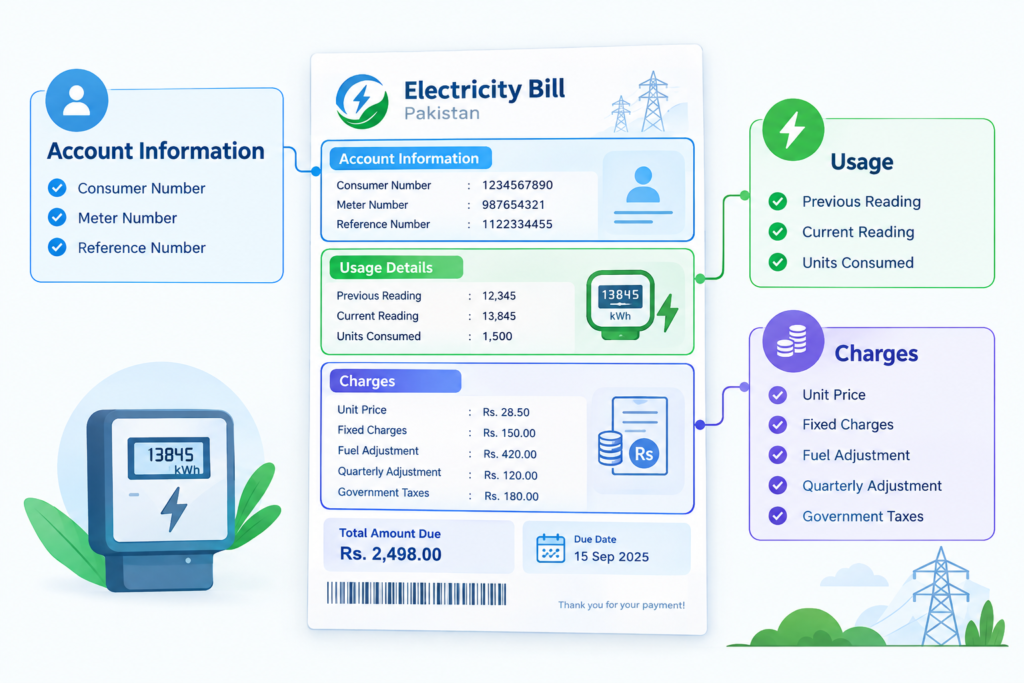
As for a quick answer, your electricity bill in Pakistan has three main sections: your account information (which includes the consumer number, meter number, and reference number), your usage (comprising the meter readings and the units consumed), and the charges (made up of the unit price, the fixed charges, the fuel adjustment, the quarterly adjustment, and the government taxes). When you know where each item is located, it then takes less than two minutes to go through the bill
Last updated: October 2026
What does an electricity bill in Pakistan mean?
An electricity bill is a monthly statement which your electricity company sends you in order to bill you for the power that you have used; it is put together by your distribution company (DISCO), for example LESCO, MEPCO, FESCO, IESCO, PESCO, GEPCO, HESCO, or K-Electric, depending on where you live. Although each company designs its bill in a slightly different way, the information contained in it is almost identical all over the country since NEPRA establishes the rules for all of them.
After you know how the layout is arranged, reading either a WAPDA electricity bill or a K-Electric bill is straightforward.
How to Find the Important Information on Your Bill ?
Consumer Number and Reference Number
These two figures often confuse people, but they do not refer to the same thing.
Consumer number vs reference number
| Term | What it means | Where it is used |
|---|---|---|
| Consumer number | Identifies your electricity connection permanently | Used for complaints, meter checks, and account records |
| Reference number | Identifies this specific bill or billing month | Used to check or pay a particular bill online |
The reference number is generally printed close to the top of the bill, usually beside a barcode; the consumer number remains the same each month whereas the reference number can change on each new bill.
Meter Number and Connection Details
The meter number is printed on the bill and is also stamped on the meter at your property. Make sure that both of these numbers match. If they don’t match it could be because the bill was produced for the wrong meter, even though this kind of thing does occur from time to time.
It also gives a list of your connection type (which will be residential, commercial, or industrial), your tariff category, and the sanctioned load in kilowatts.

Billing Month and Issue Date
The billing month indicates the period to which the bill refers; the issue date is the date on which the bill was produced, and the due date, which is printed separately, is the final date by which the payment must be made if a late payment charge is not to apply.
Understanding Electricity Units and Meter Reading
This section is one that most people omit, yet it is the simplest method of spotting a billing error.
Understanding your meter reading fields
| Field | What it shows |
|---|---|
| Previous reading | The meter number from last month |
| Current reading | The meter number this month |
| Units consumed (kWh) | Current reading minus previous reading |
One kilowatt hour (kWh) is equal to one unit. This is the amount of energy consumed by an appliance with a power rating of 1000 watts operating for one hour.
How to check this for yourself?
Go outside, look at your real meter, and compare it with the ‘current reading’ that is printed on your bill. If the figures don’t agree or if your bill states ‘estimated’ rather than ‘actual’, then you should file a complaint with your DISCO before making the payment.If you are looking for more information you can check from our website. you can also visit the official website as well.
How to Understand Electricity Bill Charges in Pakistan?
It is at this point that the most confusion arises, since a bill is never simply the amount of units multiplied by the rate. The following items are what usually make up the total.
Electricity unit charges: this is your basic charge and it is determined by Pakistan’s slab system. The longer you use electricity during a month, the higher the rate will be on your total number of units, not just on the additional ones. That is the reason why going over a slab limit, for example 200 or 300 units, can cause your bill to increase by more than you anticipate.
Fixed charges. This is a monthly fee calculated according to the sanctioned load and is charged even in months when your electricity usage is very low.
The fuel charge adjustment (FCA), also known as the fuel price adjustment (FPA), involves NEPRA examining the real fuel costs used to produce electricity each month and comparing them with the costs that are already included in your tariff. When the actual costs are higher, the difference is then added to your bill approximately two months later; if the actual costs are lower, you receive a deduction. This is the reason why the amount of your bill may vary from month to month even though your usage has not changed.
Quarterly tariff adjustment (QTA). This is a similar arrangement but with the reviews taking place every three months rather than each month, and it includes wider kinds of cost changes such as capacity payments and distribution costs. For instance, NEPRA approved a quarterly adjustment of approximately Rs 0.52 per unit for the period from April to June 2026, and this amount was included in the bills from September through November 2026.
Electricity duty and GST are imposed on top of the amount you use together with the adjustment charges. The rates will differ slightly according to your consumer category.
Television fee. In most DISCOs a small fixed fee is added for residential connections.

Sample bill breakdown
| Line item | Example amount (Rs) |
|---|---|
| Units consumed | 300 units |
| Electricity unit charges | 9,930 |
| Fixed charges | 400 |
| Fuel charges adjustment | 618 |
| Quarterly tariff adjustment | 156 |
| Electricity duty and GST | 1,050 |
| Total payable amount | 12,154 |
Figures are illustrative to show how the parts add up. Your own numbers depend on your DISCO, tariff category, and the month's approved adjustments.
Protected vs Non-Protected Consumers
A consumer is considered to be protected if the household has used no more than 200 units each month for six months running. Such protected consumers are charged a reduced rate per unit. If the usage goes above 200 units at any time, the connection is then classified as non-protected and, for the same level of usage, is usually subject to a considerably higher rate. It is this one rule that accounts for a large number of complaints about ‘why has my bill suddenly become so high’.
How to Read LESCO, MEPCO, FESCO, IESCO, and Other DISCO Bills
The arrangement varies from company to company, but the main sections are always there.
How to read LESCO, MEPCO, FESCO, IESCO, and other DISCO bills
| DISCO | Serves | What to know |
|---|---|---|
| LESCO | Lahore region | Reference number shown near the barcode |
| MEPCO | Multan region | FPA and QTR Adj listed separately near the bottom |
| FESCO | Faisalabad region | Meter reading history shown on the back |
| IESCO | Islamabad region | Consumer number doubles as the online account ID |
| PESCO | Peshawar region | Bill often includes a separate arrears line |
| GEPCO | Gujranwala region | Tariff category printed near the top |
| HESCO | Hyderabad region | Load shedding schedule sometimes printed on the bill |
| K-Electric | Karachi | Uses its own tariff and billing software, slightly different layout from WAPDA DISCOs |
No matter which company sends you the bill, the consumer number, the meter reading, the amount of units consumed, and the breakdown of the charge all appear in about the same order.
Common Terms Used on Pakistani Electricity Bills
Why does your electricity bill vary from month to month?
Your bill can vary even if your usage is the same due to three factors combining together. The first of these is the fuel charge adjustment, which is altered each month in accordance with the actual cost of power generation. The second is the quarterly tariff adjustment, which takes place every three months. The third is the fact that your own usage changes with the weather, as the need for cooling in summer causes consumption to rise considerably. For example, a bill that increases in September usually shows the fuel costs from July being charged two months late, rather than indicating a sudden change in your own usage.
How to Verify Your Electricity Bill Details Online?
- Go to the official billing portal of your DISCO.
- Write in exactly the same way as it is printed your reference number or consumer number.
- Carefully compare the online bill with your printed copy, one line at a time.
- Make sure that the reading on your meter, the tariff category, and the total amount due are all the same.
If there is a discrepancy between your online bill and your printed bill, call the helpline of your DISCO and have both reference numbers ready.
Common Mistakes to Check on Your Bill
– A meter reading has been marked as ‘estimated’ for more than one month in a row.
– A tariff category that does not correspond to the actual type of your connection (for example, charging a commercial connection at the residential rate or vice versa).
A load figure that has been authorised and still does not correspond to the load that you have approved.
– A bill for which you have already paid showing that there are arrears.
The number of units used that fail to correspond with the current reading when compared to the previous reading.
If you deal with any of these situations in the early stages, you can avoid being charged incorrectly and having to go through a longer dispute later on.
Frequently Asked Questions
How can I read my electricity bill in Pakistan?
Begin by checking your consumer and reference numbers, then look at your meter reading and the units consumed, and lastly examine the charge breakdown, which consists of the unit charges, the fixed charges, the fuel adjustment, the quarterly adjustment, and the taxes.
What is the reference number on an electricity bill?
It is typically printed towards the top of the bill, close to the barcode, and is not the same as your consumer number.
What are units consumed on an electricity bill?
Units consumed is the amount of kWh used during the billing month, calculated by taking the current meter reading and subtracting the previous meter reading.
How is the electricity bill worked out in Pakistan?
It is worked out by taking the units you have used at the relevant slab rate and adding the fixed charges, the fuel charge adjustment, the quarterly tariff adjustment, and the government taxes.
What is the meaning of FPA on an electricity bill?
FPA, known as fuel price adjustment, is a monthly charge or credit showing the difference between the actual fuel costs and the fuel costs already contained in your base tariff.
What does QTA mean on an electricity bill?
QTA, known as quarterly tariff adjustment, is a cost adjustment made every three months and includes items such as capacity payments and distribution costs.
What steps should I take to check my electricity bill details online?
Go to the billing portal of your DISCO and enter your reference number or consumer number to view and check your bill.
What is the difference between a consumer number and a reference number?
Your consumer number stays constant for your connection, while the reference number refers to one particular bill and may change every month.
Why does my electricity bill go up each month?
The most common reasons are the fuel charge adjustment changing, the quarterly tariff adjustment, seasonal usage, and moving up to a higher slab.
What details are given on an electricity bill?
The consumer number, the reference number, the meter number, the billing month, the meter readings, the units consumed, the charge breakdown, and the total amount due with its payment date.